SC strikes down J&K law provision denying regularisation to academic arrangement employees



12/03/2026
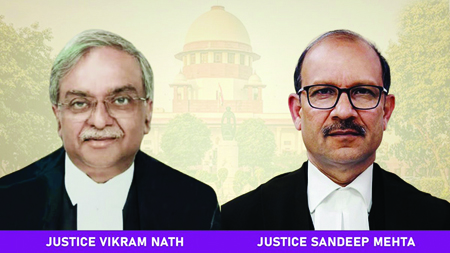
New Delhi, Mar 11: The Supreme Court has struck down a provision of the Jammu and Kashmir Civil Services (Special Provisions) Act, 2010 that excluded employees appointed on an "academic arrangement" basis from being considered for regularisation, holding that such exclusion violates the constitutional guarantee of equality.
A bench comprising Justices Vikram Nath and Sandeep Mehta passed the judgment while allowing a batch of civil appeals led by Abhishek Sharma against the Union Territory of Jammu and Kashmir and others.
The appeals challenged a February 22, 2023 judgment of the High Court of Jammu and Kashmir and Ladakh which had dismissed intra-court appeals and writ petitions seeking regularisation of employees engaged in government medical institutions on an academic arrangement basis.
Background of the case
The dispute arose from appointments made under the Jammu and Kashmir Medical and Dental Education (Appointment on Academic Arrangement Basis) Rules, 2009, under which doctors and teachers were engaged temporarily in medical colleges to meet staff shortages.
The appellants contended that despite serving for long periods and fulfilling the conditions laid down in Section 5 of the 2010 Act, they were denied consideration for regularisation solely because their appointments were categorised as "academic arrangement".
They argued that such exclusion created an arbitrary classification among similarly placed employees and violated Articles 14 and 16 of the Constitution.
Court's observations
Allowing the appeals, the Supreme Court held that the exclusion of academic arrangement employees from the scope of regularisation under the 2010 Act was unconstitutional.
The bench observed that the state cannot adopt artificial classifications to deny statutory benefits to employees who otherwise fulfil the requirements for regularisation.
"The State, as a model employer, cannot adopt artificial classifications to deny statutory benefits. Repackaging contractual engagements under a different nomenclature while denying regularisation violates the equality mandate under Articles 14 and 16 of the Constitution," the court said.
The bench noted that once employees satisfy the statutory conditions prescribed under the law, the mere description of their engagement as "academic arrangement" cannot be used as a ground to deny them consideration for regularisation.
Provision declared unconstitutional
The court specifically declared Section 3(b) of the 2010 Act unconstitutional to the extent that it excluded employees appointed on academic arrangement basis from consideration for regularisation.
The bench held that such exclusion was discriminatory and inconsistent with the equality guarantee under Article 14.
Directions to the government
Setting aside the High Court judgments dated February 22, 2023 and December 27, 2024, the Supreme Court directed the J&K administration to consider the cases of the appellants for regularisation in accordance with Section 5 of the 2010 Act.
The court directed that the exercise be completed within four weeks.
It further ruled that the benefit of the judgment would extend to all similarly situated employees appointed on an academic arrangement basis who meet the statutory requirements under the Act.
With these directions, the Supreme Court allowed the batch of appeals and disposed of all pending applications.
Share This Story |
|
Comment On This Story |
|
|
|
|