Ladakh a living land of dharma for centuries: Amit Shah



Rapid transformation in Ladakh since 2019, UT remains PM Modi’s focus: Shah
02/05/2026
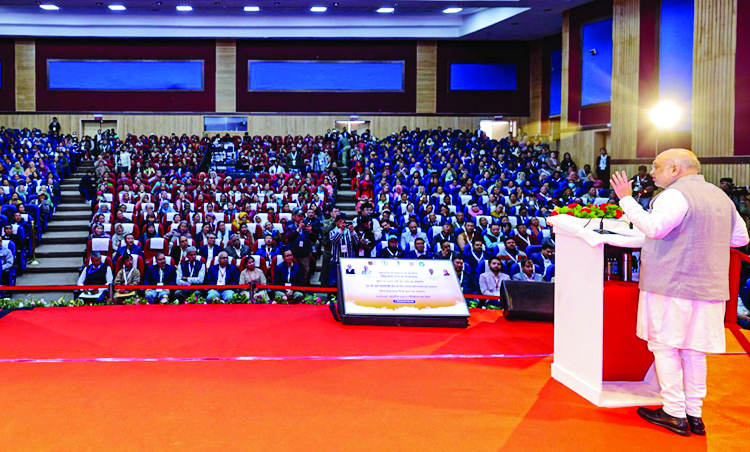
Leh/Jammu, May 1: Union Home Minister Amit Shah on Friday described the return of sacred relics of Lord Buddha to Ladakh after 75 years as a "historic reunion" and said that the Union Territory has remained a "living land of dharma" that preserved and nurtured Buddhist knowledge for centuries.
Stressing the relevance of Buddha's teachings in modern times, Shah said the message of peace, compassion and the middle path was even more important today than it was 2,500 years ago.
Speaking after inaugurating the exposition of sacred holy relics of Tathagata Buddha and the 2569th Buddha Purnima celebrations at Jivetsal in Leh, Shah said, "Ladakh has been a living land of dharma for centuries. When the Dalai Lama comes here, he says this land is not merely a geographical land but a living laboratory of Buddhist culture and compassion."
Calling Ladakh a land of compassion, he said this land has preserved and nurtured knowledge. "Whenever Buddhism faced crises, this land worked to protect the teachings of Buddha. And when peace returned, it helped to expand and carry forward that preserved wisdom," he added.
Shah said that unless one internalises knowledge and makes it a part of oneself, liberation is not possible.
"Knowledge is incomplete without spiritual practice, while spiritual practice without knowledge is blind. Therefore, the union of spiritual practice and knowledge is the right path. Even with these, if there is no moral discipline, one cannot lead a truly wise life. The basis of a life of wisdom is moral discipline," he said.
Shah said it was through Ladakh and adjoining routes that the teachings of Tathagata Buddha, which originated in India, spread to China and several other countries.
"The message that emerged from the land of Ladakh has become a guiding force that helps many people around take their lives forward. The presence of these sacred relics in Ladakh reminds us that India's civilisation has, for thousands of years, given the message of peace and coexistence," he said.
He said in a diverse region like Ladakh, this message becomes even more relevant. "This heritage still tells us that amidst conflict and unrest, only the path of peace and compassion can provide solutions."
He said the return of the relics has boosted the significance of Buddha Purnima for the people of Ladakh.
"These sacred relics have come to Ladakh after 75 years. It is as if Buddha himself is present here today," Shah said, adding that followers of Buddhism and other religions in Ladakh and Kargil would draw spiritual energy from the relics alike.
Highlighting Ladakh's role in the spread of Buddhism, Shah said Kashmir was once an ancient centre of Buddhist studies, Mahayana philosophy and Buddhist art, from where Ladakh first came into close contact with Buddhism.
Emperor Ashoka's envoys laid the foundation of Buddhist influence in Ladakh through Kashmir and Gandhara, while Mahayana Buddhism expanded in the region during the Kushan period between the first and third centuries CE.
The Silk Route linking Kashmir, Leh, Yarkand, Khotan and Tibet became a channel not only for trade but also for ideas, monks, manuscripts and artistic traditions.
Later, Tibetan influence between the seventh and tenth centuries further enriched Ladakh through Mahayana and Vajrayana traditions, Shah added.
Stressing the relevance of Buddha's teachings in modern times, Shah said the message of peace, compassion and the middle path was even more important today than it was 2,500 years ago.
"Amid conflict and unrest, only the path of peace and compassion can provide solutions," he said.
Shah also appealed to the Ladakh administration to ensure smooth arrangements so that followers of all faiths, especially Buddhists, could visit and pay obeisance to the relics.
Later, addressing another gathering in Leh after launching several dairy projects, the home minister praised the people of Ladakh and Kargil for their patriotism and sacrifices in safeguarding the country's borders.
Whenever danger came from across the border, he said, the people of Ladakh stood in defence of the nation before the Army reached.
"The Army reached later. First, the people of Ladakh took bullets on their chests to protect the nation," Shah said, adding that the whole country -- from Kashmir to Kanyakumari and from Dwarka to Kamakhya -- knows and appreciates this history.
The home minister, who is on a two-day visit to Ladakh, said he has visited the Union Territory after seven years and was glad to be there on Buddha Purnima.
Shah said Ladakh was a model of rapid transformation since the 2019 bifurcation of the erstwhile state of Jammu and Kashmir, and listed sweeping political, social and economic changes in the Union territory.
The region has remained at the centre of Prime Minister NarendraModi-led government's development agenda, he said.
Shah said Ladakh had long demanded Union territory status due to lack of development and asserted that the decision had brought visible change across sectors.
His remarks came amid renewed calls by the Leh Apex Body and the Kargil Democratic Alliance (KDA) for resumption of talks with the Centre on statehood and inclusion under the Sixth Schedule.
"Ladakh had an old demand to be made a Union territory. The basic reason for this demand was that development was not taking place here. Now I want to tell you what has been done after it was made a Union Territory in 2019," Shah said.
He said that Ladakh has now seven districts and 193 panchayats, with five new districts - Sham, Nubra, Changthang, Zanskar and Drass - created and notifications already issued.
Shah said that local languages had also been given administrative recognition. "Earlier only Hindi and English were in use, but now Bhoti, Purgi and Urdu have also been accorded importance".
Highlighting infrastructure growth, he said road length in Ladakh has increased from about 1,799 km before 2019 to 4,040 km now. "The road constructions has almost doubled."
The Centre bifurcated the erstwhile state of J-K into two Union territories - Jammu and Kashmir and Ladakh - on August 5, 2019, when it also abrogated Article 370 of the Constitution that gave special status to the erstwhile state.
Shah said that the number of bridges has risen from 19 to 72 increasing the number by three times.
Spelling out development in other sectors, he said that mobile towers have increased from 344 to 653, while helipads have gone up from seven to 41, he said. "Snow-clearing machines, crucial for the region, have increased from 60 to 215."
On power infrastructure, Shah said grid-related works have increased from 145 to 184, while distribution transformers have gone up from 1,182 to 3,153.
"I am giving these figures on this scale because after becoming a Union Territory, it (Ladakh) has remained the focus of the NarendraModi government, the focus of the prime minister of the country, and so many development works have taken place together," the minister said.
Share This Story |
|
Comment On This Story |
|
|
|
|