Kashmir has many untold stories: Imtiaz Ali



09/09/2026
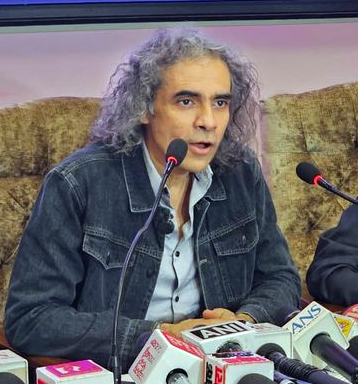
SRINAGAR, Sep 8: Kashmir has many untold stories, and there is no place as cinematic in the entire world as the Valley, Filmmaker Imtiaz Ali said on Tuesday.
Interacting with the reporters on the sidelines of the first International Film Festival of Jammu and Kashmir (IFFJK) at the SKICC here, Ali admitted to being fascinated by many characters from Kashmir, including the mystic Lal Ded.
"However, making a film on her is quite difficult because of her stature and what she represents — she was almost like the mother of the culture. And she is a saint revered equally by people of every religion. That is the best and greatest thing about her," he said, adding to his objects of fascination the poetess Habba Khatoon.
The director, whose filmography includes Jab We Met, Rockstar, Love Aaj Kal and Amar Singh Chamkila, said if he ever finds courage and capability and intellect, he would "definitely want to make something" on these figures.
"Also, about the common people of Kashmir. There are a lot of stories in Kashmir that have not surfaced. Usually, Kashmir has been viewed from just one or two angles: either it is heaven and the most beautiful place, or something else entirely is happening here. But the normal Kashmir is very interesting," he said.
Ali asserted that a comedy movie in Kashmir would be wonderful "because I feel Kashmiri humour is also very interesting."
On Laila Majnu, extensively shot in Kashmir, Ali said he has always been fascinated by returning to Kashmir and shooting in the valley.
"There is no place as cinematic as Kashmir in the whole world. You people must know, since you have come here carrying cameras. And whenever we have shot in Kashmir, the films have turned out very well, and we have had a wonderful experience," he said.
The filmmaker said the biggest merit of having such a film festival is the people thronging it.
"And they won't view it through any set narrative; they will see Kashmir with their own eyes. They will see the Kashmiri people with their own eyes. Whatever new insights they gain, they will make films on that," he said.
Ali said there could be fewer bigger occasions than the festival, where so many filmmakers and artists would come to Kashmir from different fields.
"They don't need to be told anything; they themselves are creative. When they meet you, they will understand. When they see things here, they will form their own impressions," he said.
Ali also tipped his hat to the "talented and sensitive" Kashmiris, who, he said, take a little time to open up, but show their true craft when they do.
"I feel Kashmiri artists haven't broken through in mainstream acting, direction, or singing as much as they deserve to, but the talent is abundant. Boys and girls are eager to perform, direct, and sing," he said.
The director said that everyone wants to come to Kashmir, even Steven Spielberg, and the mass arrival leads to the creation of an ecosystem.
"I feel this is a very wonderful initiative. Along with international voices, local voices will also emerge, because this is an era where, thanks to social media, everybody is listening to each other," he said.
Ali urged the locals to understand that cinema is not a bad thing, and they must allow children to be involved in it because "Why not? Where else will I get better-looking people than Kashmiris?"
He said that over the last 60 years, filmmakers have not gotten over just the landscape of Kashmir and are still "reeling" under its spell.
"So far, cinema has mostly explored familiar spots like Pahalgam, Aru, and Chandanwari. When I visited Gurez, I wanted to shoot there. Many places have barely been captured," he said.
All the same, Kashmiri culture and Kashmiri music are also coming through, he said.
"Whether it is 'Bumbro' or, in my own film, portraying a Kashmiri Pandit wedding and traditions — Things that are genuinely Kashmiri. Slowly, that cultural aspect is coming in. Earlier, only the body of Kashmir was seen; now, gradually, the soul of Kashmir will also be seen," the auteur added.
Ali said that anyone who has shot a film in Kashmir has rarely complained, yet urged for streamlining, a single-window clearance, and government support as naturally essential to smoother filmmaking.
On the role of AI in films, the director said it will remain just another tool for filmmakers, not more.
"It will hone and slightly change how films are made, but at the end of the day, it is machine learning … I would never want AI involved in scriptwriting or creative breakdowns. That must remain human," Ali said.
Share This Story |
|
Comment On This Story |
|
|
|
|